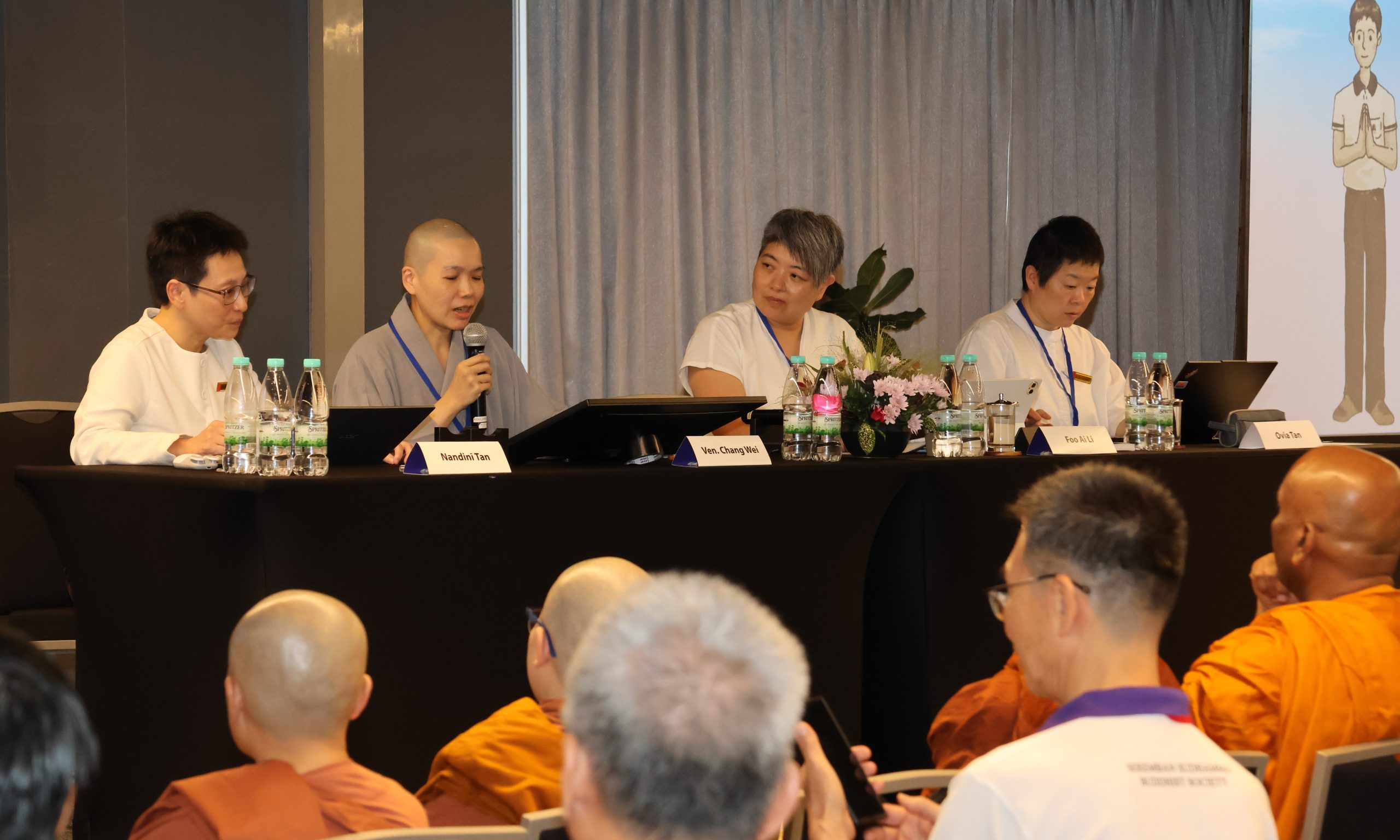
| Chairperson | Foo Ai Li |
|---|---|
| Speakers | Venerable Chang Wei Executive Officer of Dharma Affairs at Dharma Drum Mountain (DDM) |
| Nandinī Tan Meng Fong Director of Nalanda Centre |
|
| Rapporteur | Ovia Tan |


Holistic Education for Integral Human Development
Forum 4 – Volunteers – Serving Others, Awakening Ourselves
Forum 4 – Volunteers – Serving Others, Awakening Ourselves
Introduction
Buddhist organisations are dependent on dedicated volunteers to carry out their educational mission. Volunteers are what makes the temples and Centres function from greeting visitors, facilitating Dhamma Schools, serving behind the scenes, carrying much of the fund raising and operational load. Volunteerism is more than a fulfilment of duties; it is a living practice of Dhamma that transforms both the community and individual.
Because volunteers are the backbone of the organisation, a well structured “Volunteer Programme” is essential. A thoughtful program ensures that those who give their time experience an efficient, meaningful, and well-organised process. When we manage volunteers effectively, everyone benefits – leaders, staff, volunteers, and the community. To create a strong volunteer program, leaders must understand volunteers and what they need in order to thrive. Buddhist organisations should prioritise the psychological well-being and spiritual growth of volunteers, helping them to self-improve while serving others.
Forum Objectives
Forum 4 aims to establish sound strategies in forming sustainable Buddhist communities supported by long-term, passionate, and dedicated contributors. It invites leaders, teachers, and volunteers to reflect on how they can find lasting meaning in their service and transform their selfless acts into progress on the Buddha’s path.
Speech
The Path to Engagement and Spiritual Growth
Introduction
The speaker began the session by introducing “The Common Endeavor of Buddhists” – a teaching curriculum developed by Venerable Master Sheng Yen. It is a set of guiding principles to inspire and unify Buddhist practitioners in their daily lives and practice. It expresses ethical and spiritual commitments that help individuals benefit themselves and others while staying connected to the Buddha’s teachings.
At its core, the Common Endeavor includes the following ideals:
- Faith – in the Buddha, Dhamma, and Sangha.
- Uplifting the Character of Humanity – Strive to improve one’s character and contribute to creating peace, harmony, and well-being in the world.
- Gratitude and Mutual Benefit – First be grateful and repay kindness; by benefiting others, you also benefit yourself.
- Wholehearted Effort – Exert effort without measuring, approaching life and practice with sincerity.
- Kindness, Compassion, and Wisdom – Practice kindness and compassion without enemies; cultivate wisdom that brings clarity rather than vexation.
- Mindful Living – Use time wisely, stay diligent, cultivate physical and mental health.
- Fields of Merit – Sow the seeds of wholesome actions freely, without fear, hardship or criticism.
- Joy in the Dhamma and Meditation — In every moment, feel the joy of the Dhamma and abide in the bliss of meditative practice.
- Devotional Practice — Recite the name of Avalokiteshvara (Guanyin) Bodhisattva and Amitabha Buddha as a form of continuous practice and aspiration.
- Embracing “Practice in Service, Service in Practice,” – helps to achieve the dual goals of benefiting sentient beings and self-perfection.
The meaning and application of Common Endeavour include the following practices:
- Enhance Interpersonal Relationships – Being grateful and expressing it through repaying kindness.
Gratitude is not merely an inner feeling but an active responsibility toward society. When we recognize the kindness, we have received from individuals, communities, and society at large—we naturally feel the urge to give back. A key principle here is that by benefiting others, we ultimately benefit ourselves. - Cultivating harmony through compassion and wisdom.
In any workplace or human endeavour, conflicts and contradictions are inevitable. Differences in views, interests, and circumstances naturally arise. To resolve these challenges, we must rely on respect, tolerance, empathy, and understanding. Rather than competing with others for gain or recognition, we should focus on doing what we can within our own capacity. When the heart is guided by compassion, there are no enemies; when guided by wisdom, there is no agitation or resentment. By nurturing tolerance within ourselves and understanding the law of cause and effect, we learn to respond calmly, reduce suffering, and transform conflict into opportunities for learning and harmony.
- Nourishing merit and virtue.
To cultivate merit, one must adopt the mindset of not fearing hardship, criticism, or rebuke. Sowing the fields of merit requires perseverance, humility, and sincerity, as genuine virtue is often tested through difficulty. Acts of charity, patience in adversity, and selfless service may not always bring immediate recognition, yet they quietly accumulate lasting merit. Those who give with a pure heart are truly blessed, for their generosity enriches not only others but also their own inner peace and moral strength.
Strategies for Engaging Volunteers
- Clear Mission and Vision – communicate Dhamma propagation goals, service philosophy so volunteers know the value of their participation and contribution.
- Teach According to Aptitude – assessing each individual’s disposition and background, be assigned to utilise their strengths for efficiency.
- Establish Support Systems – build trust, emotional support, regular meetings and exchange to enable volunteers maintain stable mindset when facing challenges.
Impact and Analysis
A well-established Buddhist volunteer system has a significant impact on individuals and the Society in many ways:
- Individual Level – improved mental health by learning to face life’s challenges with mindfulness, find meaning and a sense of accomplishment through serving others.
- Group Level – by building trust through shared services, promotes operational efficiency, harmonious and supportive work environment.
- Spiritual Level – gradually internalise and integrate practice into their daily lives.
Challenges and Future Outlook
Volunteers face time pressure, misunderstanding about spiritual welfare of the oneself and others, managing home, work and service indirectly affect the offering of volunteer participation. The Buddhist community should take measures to expand influence and publicity, so that more people understand the value of spiritual volunteerism.
Conclusion
Recruitment and growth of Buddhist volunteers is a gradual process, which benefits the individual and promotes the spread of the Dhamma in the society. The volunteer’s path is not solitary, rather it is a great service to humanity. Ultimately it requires a sincere and heartfelt companionship.
Field Engagement Session (21 December 2025)
On the day after WACANA, DDM hosted a Field Engagement Session, welcoming forum participants to further explore how DDM applies the guiding principles in practice. All participants were warmly welcomed by Venerable Chang Zao, Chief Monastic of Dharma Drum Mountain Sangha Malaysia, Sangha members, and their devoted DDM volunteers.
Participants were guided around the centre and introduced to DDM’s Volunteer Training Programme by Venerable Yan Jian, Deputy Chief Monastic of DDM Sangha Malaysia. Venerable Yan Jian outlined a structured pathway for volunteers, beginning with a half-day New Volunteer Training or a 10-month Merit Field Programme, followed by 20 hours of practical service across different volunteer groups, and progressing to intermediate and advanced training. Master Sheng Yen’s teaching on the Four Kinds of Environmentalism, namely spiritual, natural, living, and social environmentalism, emphasising that purifying the mind is the foundation for uplifting human character and fostering harmony in society.
Serving Others, Awakening Ourselves!

Introduction
Sister Nandinī Tan commenced her presentation with Nalanda’s Core Value of ‘Service’. “Living not just for ourselves, but for the welfare of others as well. Doing the needful and being altruistic in rendering services to the world.”
“SERVICE” is one of Nalanda’s Eight Core Values that guides every member and volunteer to live a life guided by compassion and responsibility. A Buddhist volunteer, performing ‘Service’ is not merely an outward action or duty; it is a path of inner cultivation. Through selfless service, we train the mind and heart, gradually letting go of ego, deepening compassion and wisdom, and allowing our actions to become a means of purification — benefiting both ourselves and all beings.
In every thriving Buddhist organisation, volunteers for the backbone of its work. They are the first faces that greet visitors, the steady hand that keeps operations running, and the compassionate presence that supports learning and practice. Volunteering is not simply an act of giving time and effort, but is an integral part of cultivation generosity, moral discipline and mental development. The Buddha mentions that the gift of the Dhamma is the highest gift. Volunteers enable the sharing of Dhamma and contribute to the spiritual well-being of others.
Volunteerism in Nalanda is a well-structured, value-based practice designed for personal and communal well-being and cultivation. The approach is to sustainable, joyful and deeply transformative and based on two motivation.
Two-Fold Motivation for Service
Nalanda’s volunteerism is rooted in two deep aspirations that balance compassion for individuals with responsibility for Dhamma.
- Compassion for All – The wish for all beings to be free from suffering and to find happiness. (不愿众生苦)
- Preserve the Dhamma – Commitment to the endurance and non-decline of the Buddha’s Dispensation. (不愿佛教衰退)
The Purpose of Volunteering: The Dual Nature of Service
The purpose of volunteering lies in its dual nature, where service becomes both an offering to others and a path of inner cultivation.
- Serving Others – Through volunteering, we help create conducive conditions that actively support learning, practice programs, and community operations that sustain and strengthen the Buddhist community.
- Awakening Ourselves – Volunteering is a powerful means of self-awakening. Through acts of service, we cultivate essential qualities such as kindness, patience, humility, and wisdom. By working harmoniously with others and facing challenges mindfully, we build confidence, deepen self-awareness, and strengthen our sense of spiritual purpose. Service thus becomes a living practice—transforming everyday actions into opportunities for inner growth and purification.
Nalanda Core Values
Nalanda Buddhist Society identifies its “Eight Core Values”; as the guiding principles for the members and volunteers to embody the “Nalanda Spirit”. Nalanda members, devotees, and volunteers, believe in the following Eight Core Values:
- Compassion – Being kind and supportive of others in our thoughts, speech, and conduct.
- Courage – Being strong and determined in the face of adversities and challenges in life.
- Respect – Being respectful of our elders, teachers, fellow practitioners, and all sentient beings.
- Integrity – Living by righteous means, principles, and values.
- Service – Living not just for ourselves, but for the welfare of others as well.
- Faith – Having right understanding and deep confidence in the Buddha-Dhamma.
- Learning – Continuous learning and improvement as individuals and as a community.
- Reflection – Living mindfully and purposefully towards liberation from afflictions.
Strategies for Sustainable Volunteerism
Sister Nandinī Tan shared Nalanda’s continuous strategies and effort in nurturing sustainable Buddhist volunteers:
- Role Matching – placing them in roles that align with their abilities and interests.
- Continuous Learning – provide skills & communication training.
- Mentorship & Feedback – guidance and feedback help maintain service quality and personal motivation surrounded by spiritual friends.
- Volunteer Welfare – care for their spiritual, emotional and physical well-being.
- Recognition & Appreciation – acknowledgement expressed through gratitude.
Conclusion
Volunteerism is not a one-off activity. It is a lifelong practice of learning and service. Nalanda’s mission is to build a community rooted in compassion, mindfulness, and shared responsibility. Nalanda is dedicated to nurturing a vibrant Buddhist community that actively supports spiritual practice, personal growth, and the overall well-being of all the members and volunteers, fostering harmony, wisdom, and collective care.”
Forum 4 Conclusion

Both speakers emphasised the Buddha’s teaching that the path to liberation is one of practice, not merely intellectual understanding. Service is such a practice – a fertile field for sowing seeds of wisdom and compassion. It transforms the organisation and the individual. In serving others, the volunteer creates conditions for awakening. This mutual nourishment sustains both the community and prolongs the Buddha’s Dispensation for generations to come.
Question and Answer Session
Answer by Venerable Chang Wei:
- Aging volunteer base: greater youth involvement is needed.
- Overreliance on technology may restrain spiritual practice.
- Spiritual practice is often given lower priority compared to material pursuits.
Answer by Sis Nandini Tan:
- Uncertainty in volunteer commitment; accept change as a natural law.
- Succession planning through volunteer pairing and role continuity.
Answer by Venerable Chang Wei:
- Encourage engagement in good deeds and selfless service as a source of intrinsic motivation and spiritual growth.
Answer by Venerable Chang Wei:
- Encourage family members to attend events as an initial step, helping them to understand and appreciate the benefits and impact of volunteering.
Answer by Sis Nandini Tan:
- Realise Well-Beings, with emphasis on Family Well-Being and Domestic Bliss.
- Recognize that “no balance is true balance”; priorities should be set according to circumstances and adjusted mindfully.
- Leaders understand volunteers’ purposes, priorities, and personal preferences.
Note:
Nalanda members and volunteers, strive to attain balance and happiness in our lives, as well as to help others achieve greater joy and success in their lives by realising the Six Well-beings:
- Physical well-being and good health.
- Mental well-being and joyful living.
- Family well-being and domestic bliss.
- Economic well-being and career success.
- Interpersonal well-being and social harmony.
- Spiritual well-being and inner peace.
Answer by Sis Nandini Tan:
- Role matching based on strengths and interests.
- Continuous learning opportunities.
- Mentorship and constructive feedback.
- Kalyāṇamittatā (spiritual friendship).
- Volunteer welfare and well-being.
- Progressing beyond a merely harmless life toward a noble and meaningful life.
Answer by Venerable Chang Wei:
- Core principles: accept, face it, and let go.
- Group sharing sessions after performing service for feedback.
- Reflection practices that cultivate gratitude for the opportunity to serve.